
Original post:
Here is one reply in a topic there that stood out to me:Since it's not that surprising the final two teams standing represent the Big Sky and MVFC (with at least one of them being a Montana/Dakota school) I figured it would be a good time to assess the current environment in a bit more detail and through different lenses.
Two things really stand out to me...
- Economics and migration have really hurt FCS football in the Southeast. This region is a shell of what it was when Georgia Southern, App State, Jacksonville State, Furman, and Wofford, etc. were at their peak. And with concerns over investment (not just financial but emotional investment) I'm not sure what the path back looks like. From a far, Furman has several key attributes to allow them to compete at a high-level if the will is still there in Greenville. Because without desire there's little hope...
- Who from Texas can actually take the next step? These programs still seem a step behind despite the perception they're in the Meca of football. Or is there an oversaturation of D1 programs in the state? Even the Big 12 and G5 Texas schools outside of Texas Tech are struggling to keep up it seems. Heck, Texas A&M is still trying to recapture the RC Slocum Era and Texas continues to underachieve. I do believe hubris in the state works against them. This assertion comes from spending time at UT-Austin, Texas A&M, Rice, & Houston to study their respective athletic cultures.
It's a multi-faceted issue, because FCS is now basically four subgroups:
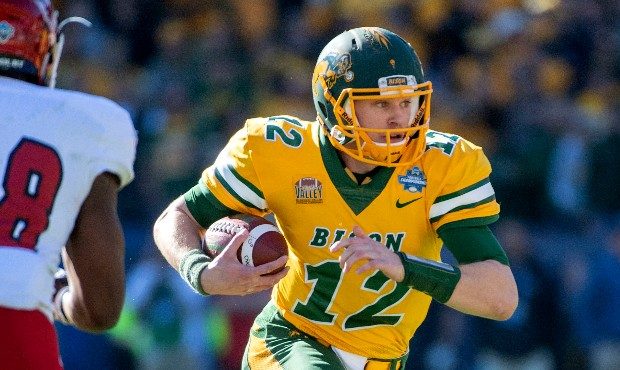
The MVFC and Big Sky, which is playing at a low G5 level without the benefit of bowl games;
The South (SLC, SoCon, UAC, OVC-Big South), which has been hollowed out by FBS outmigration; and
The Northeast (Ivy, PL, CAA, NEC), which exists in its own orbit and doesn't fare well outswide it; and
The HBCUs (SWAC, MEAC) which really don't care about the other three.
Because these groups are self-selective and do not cross-schedule (MVFC do not play the CAA, HBCU's generally do not play other southern conferences, etc.) there is little growth within the subdivision as a whole because the same recruitring habits predominate, and there is no growrth across coaching disciplines. Penn didn't consider a candidate from Montana, they went with the regional pick. Would Illinois State bring in a coordinator from the SWAC? The next coach at VMI won't be from Tarleton State.
 (My emoji opinion is mine, though)
But... the remaining Southern FCS teams also look insular to me as well.

Also, in another reply to the quoted post:
Do you agree to the poster's sentiments?There is a clear separation in the Big Sky and MVFC too...
- Big Sky is the Montana schools with UC Davis and perhaps Idaho being the tweeners. NAU, EWU, Idaho State, Weber State etc are all swimming upstream...
- The MVFC clearly has the most depth but there's also a line in the sand in terms of ceiling. South Dakota, North Dakota, Youngstown State, and SIU are similar to the top programs in other FCS conferences in that they're trying to crack the code. IIRC, Illinois State hadn't beaten NDSU in 14 years prior to their historical playoff run. That said, 2 finals appearances in the last 10-15 years under the same coach in Normal is damn impressive imo. Rock solid program! Conversely, I'm interested to see how SDSU adapts moving forward. Has coaching turnover and/or general instability caused cracks in the foundation or was this season simply a transition year? Those in Brookings seem a bit unsure....
Yet another:
I'm afraid G5 gets the same level of national exposure as the FCS.It's worth remembering that when moving from FCS to FBS, the trade-off is that you're (in theory) giving up a more interesting postseason for a more interesting regular season, and the media exposure that comes with it.
Do you think the HBCUs will be forced to play the Ivies or PL programs if the NCAA would not allow non-countables outright?One practice I applaud is the PL's, CAA's, and Ivy's aversion to low-rent DII and/or NAIA games.
Discuss.





 I'm not sure the average B1G0 fan in Illinois, Indiana, or Ohio knows the difference between a MAC team and a MVFC team.

